
Thousands with PMR are seeing real, documented change in symptoms they were told would never go away.





For as long as it has had a name, polymyalgia rheumatica has been treated as a problem of the muscles.
"It's inflammation in the muscles." "It's a mild arthritis of the shoulders and hips." "It's what happens after seventy." "Your bloods are back to normal, so the disease is under control." The same short list of answers, handed to hundreds of thousands of people who woke up one morning unable to lift their arms — all of them resting on one assumption: that if the inflammation is down, the body should be fine, and whatever is left is just age.
But "it's the muscles" doesn't explain a muscle enzyme test that comes back normal. It doesn't explain a strength test that comes back normal on a morning the patient had to slide out of bed onto the carpet. It doesn't explain both shoulders and both hips locking up on the same night, or arms that feel like they weigh forty pounds each, or an exhaustion a full night's sleep does nothing for. Something has to be causing all of it. And "it's the muscles" was never a real explanation — it was the best medicine could do with half the picture.
In 2026, that picture is finally starting to fill in.
Thousands with PMR are finally getting their lives back — reclaiming the version of themselves they thought they lost the morning it started — not through another prescription, not through another steroid, not through another biologic, but through a discovery that traces back to what the condition did to one specific part of the body. Not the muscle. Not the joint. A part no standard test was ever built to look at.
And it explains something every PMR patient already knows and no doctor has fully answered: why the prednisone clears the inflammation every time — and why the inflammation keeps coming back every time, no matter how long it's been.
And once that finding makes sense, polymyalgia rheumatica stops looking like a mystery — and starts looking like something with a clear cause, and a real way forward.

What the Research Really Found
There is a reason every test kept coming back normal — and it's not the reason patients were given.
ESR and CRP measure inflammation in the blood. They can tell you the body is inflamed. They can't tell you where. The CK test looks inside the muscle itself for damage — and finds none. An X-ray looks at the bone. The rheumatologist's strength test measures what the muscle can push against — and the muscle pushes just fine. Every standard test a PMR patient has ever had was built to look at one thing at a time — the blood, the bone, the inside of the muscle.
Not one of them was built to look at the one place the inflammation actually is.
Most people with PMR have already been told what's wrong. That it's inflammation. That it's somewhere in the shoulders and hips. That the prednisone is keeping it down. That when the bloods are normal, the inflammation is under control.
All of that is true.
What nobody told them is where. Where the inflammation really sits, if it isn't in the muscle. Why it takes both shoulders and both hips on the same night. Why a muscle that tests perfectly strong can't lift a coffee cup. And why the bloods can be normal while the body isn't.
Over the last few years, a new field of research has been growing around a tissue most doctors were never trained to think about — and in the last three years, that research finally turned to PMR. The first step was simple. Instead of testing the blood, researchers put newly diagnosed PMR patients into a whole-body scanner and looked at where the inflammation actually was.
The soft tissue around the muscles and joints. That's where every scan pointed. It has a name, and it's a name most PMR patients have never heard from a doctor.
The tissue is called fascia — the water-rich layer of connective tissue that runs through the whole body as one continuous sheet.

Fascia is what fills all the empty space in the body. Between the muscles. Around the nerves. Around the organs. Under the skin. Around every joint. Anywhere there would otherwise be a gap, from the scalp to the soles of the feet, there is fascia — one continuous sheet, and nothing in the body moves without moving through it. In a healthy body it is soft, hydrated and slippery, a wet cushion filling every space it sits in.

You feel nothing from it, because you're not supposed to. It is invisible by design. And it stays that way for one reason: the body keeps feeding it the specific nutrients it needs to stay soft, hydrated and full of water.
For decades, nobody looked at this tissue in PMR. The whole field was built on the word in the name — myalgia, muscle pain — and the fascia sat right against the muscle, never checked.
Then a research team did something simple. They sampled the muscle, and then they sampled the fascia around it.
That was the finding that flipped the picture upside down. The inflammation was real — every PMR patient's bloodwork already said so. It just wasn't in the muscle. It was in the fascia wrapped around the muscle.
Two MRI teams then went further. They scanned the fascia of PMR patients directly — before the first dose of prednisone — and measured how much of it was involved.
What they found was not normal.
Three research teams. Three methods. The same tissue, in the same state.
The fascia in these patients had dried out. It had thickened. It had densified — the soft, wet cushion around the shoulders and hips hardening into a rigid layer around the muscles, tendons and nerves running through it. Not just in the morning. Around the clock.

The normal test results were never proof that nothing was wrong. The blood tests look at the blood. The CK test looks inside the muscle. Neither one was built to look at the fascia in between. Which is why the neck won't turn to back out of the driveway, why both arms stop at the waist, and why a strength test can be perfectly normal on a morning the body won't move.
Which leaves the question every patient asks next. How does healthy fascia end up like that — overnight, on both sides at once?
For most of the last thirty years, rheumatology has answered that question with a shrug. Something sets it off. In some people it never settles. Nobody knows why. But over the last three years, as the fascia findings came in, that answer has been changing — because once you know where the problem is, the question of how it got there has a much shorter list of possible answers.
Start with what has been known for a long time. Some people carry a genetic variant — HLA-DR4 — that makes their body far more likely to go into survival mode, and far less likely to come back out. That's why PMR runs in families, and why it's far more common in people of Northern European descent. It's also why almost every PMR patient can describe what came right before it. For some it was a virus — a flu or a chest infection that hung on for weeks, and the shoulders locked up the week it cleared. For some it was a surgery, a fall, a season of hard work. For many it was a stretch of intense stress — a death, a sick spouse, a year of holding everything together and then the funeral. And for a lot of people it was nothing they can name at all. In a body carrying the variant, survival mode can switch on by itself — the way it sometimes does after fifty.
It doesn't matter which. What matters is what the body does next — and that part has been mapped in detail.
This is survival mode — the same emergency response every human body runs when it faces a serious threat. Energy demand shoots up. And to pay for it, the body sends its supply of water and nutrients to the organs it can't afford to lose — the heart, the lungs, the brain — pulling it away from everything it can afford to run short for a few weeks.

Fascia is one of the first places that supply gets pulled from. And around the shoulders and hips, where the fascia is thickest and needs the most water and nutrients to stay soft, it's the first place to feel it.

For most people, this is invisible and short-lived. The threat passes. The body switches out of survival mode. Full supply to the fascia comes back. Nothing lasting happens.
In the people who develop PMR, that switch never flips back. The body stays in survival mode — and the fascia around the shoulders and hips keeps running on a fraction of the water and nutrients it needs to stay soft.
That's why it happens overnight. Survival mode is a switch, not a slope. The supply gets cut all at once — and the thickest fascia in the body, the fascia that needs the most water, sets first.
That's why it's both sides at once. A torn shoulder is one shoulder. A worn-out hip is one hip. But fascia is one continuous sheet, and the supply cut is body-wide. Both shoulders lose their water on the same night. Both hips too.
And that's where the inflammation comes from.
Dried-out, densified fascia is inflamed fascia. Tissue that has hardened around the muscles, nerves and vessels inside it is tissue under constant strain — and the body answers strain the only way it knows how. The inflammation the blood tests pick up isn't a separate disease that happened to land in the shoulders and hips. It's what densified fascia produces, every day, for as long as it stays densified.

And month by month, it gets worse. The fascia stays dried out. It thickens. It densifies further. Like a wet sponge left on the counter — soft and squishy one week, stiff and shrunken the next, and no longer able to soak water back up on its own.
And densified fascia does one thing to everything inside it. It squeezes.
It squeezes the muscles. A muscle inside dried, hardened fascia can't move freely and can't relax. It aches at rest. It sets overnight, when nothing has moved it for eight hours. It wakes up set in cement — and it stays that way until it has been warmed up and worked loose.
It squeezes the nerves. Fascia is the sleeve the nerves run through. When the sleeve hardens around them, the nerves send a nonstop stream of distress signals — and the body reads it as a threat, around the clock, and stays in survival mode.
And it squeezes the vessels. The small blood vessels that carry water and nutrients to the fascia run through the fascia itself. Hardened fascia narrows them. Less gets through. The tissue that needed more supply now gets even less.
That's the loop. The body can't leave survival mode because the fascia won't stop firing. The fascia keeps densifying because the supply never comes back — and because the supply lines running through it are being squeezed shut. And the inflammation keeps coming, because the densified fascia making it is still there.
Which is why, on its own, it never goes away. Why the prednisone clears the inflammation and the inflammation comes right back. And why every symptom a PMR patient lives with leads back to the same place.

Why Every Symptom Finally Adds Up
PMR has always looked like a disease that doesn't add up. A muscle that tests strong and can't lift a plate. Pain that shows up on both sides on the same night. Bloods that say "normal" on a morning the body won't get out of bed. Symptoms that seem to have nothing to do with each other — the ones patients have been told are age, or arthritis, or something else entirely. Once you understand the finding, they stop looking random. Not a handful of unrelated problems. One problem, showing up in a handful of places.
Fascia stays soft and hydrated by holding water — and it needs the nutrients the body supplies to do that. Wet, it moves. Dry, it sets. Overnight, with the body still and cool, the dried-out fascia around the shoulders and hips hardens in the shape the body was lying in — and every muscle it wraps is locked inside. Movement warms it and loosens it a little. Sit still again and it sets again. The blood tests can't see any of this, because the blood is fine. The fascia around the muscle is not.
An injury is on one side. PMR is on both — and that alone should have told everyone this was never an injury. Fascia is one continuous sheet through the whole body, and when the supply of water and nutrients to it is cut, the thickest sections — the fascia around the shoulder and hip muscles — dry out and harden together. The muscle underneath is strong. It's trying to lift the arm. But it's moving inside a sleeve that has set around it, and it can only go so far.
This is the one nobody explains, because the test is right and so is the patient. The strength test measures what the muscle can push. The muscle pushes fine. But to move, every muscle has to move inside the fascia around it — and when that fascia is hardened, the muscle is dragging it with every inch. The effort is real. The heaviness is real. The muscle is spending most of its strength fighting the sleeve it's wrapped in, and the test never measures that.
Sleep only restores the body on one condition: the body has to leave survival mode and sink into rest. That's when it recharges. A PMR body never gets there. The hardened fascia is squeezing nerves and muscles all night — a nonstop stream of alarm signals the body reads as a threat. It can't stand down, because the fascia won't stop firing. So it spends the night in survival mode with its eyes closed. Sleep still happens. Rest doesn't. The brain never recharges either — which is the fog. And it's why one in three PMR patients report exhaustion at the level of chronic fatigue syndrome — still there two years into treatment.

For years, PMR patients have been told the muscles are inflamed. Told it's a mild arthritis. Told the bloods are normal so the disease is under control. Told the rest is age. Left to explain to spouses and children why someone who walked five miles in April can't put on their own socks in May — while their doctors said the numbers were fine.
Now, for the first time, every symptom above is explained by the same finding — a single densified layer of fascia around the shoulders and hips, doing the same thing on both sides at once.
Not the muscles. Not arthritis. Not age. Not something a normal CRP should have ruled out.
One tissue, in one state, causing everything they've been living with — and everything they've been trying to explain — since the morning it started.
Why Nothing on the Standard Shelf Has Ever Worked
Most people who have had PMR for any length of time have cycled through the standard shelf.
Ibuprofen and naproxen, before the diagnosis. Physical therapy, which made it worse. The chiropractor. Deep-tissue massage. Turmeric. Fish oil. Collagen. Magnesium. Calcium and vitamin D for the bones. Methotrexate, if the rheumatologist pushed it. The heating pad, the electric blanket, the twenty-minute shower every morning. And prednisone — fifteen milligrams, then twelve and a half, then ten, then seven, then back to fifteen. Two to five thousand dollars a year on the physical therapies alone, none of it covered.
And every one of them follows the same pattern. A small shift, or none. A plateau. Then a cold morning, or a long car ride, or a drop in the dose, and right back to where things started.
The reason is simple: every one of them was aimed at the muscle, the bone or the blood — never at the fascia in between.

The anti-inflammatories were built to clear inflammation, and in PMR they can't even do that. The physical therapy and the massage were built to work the muscle — and the muscle was never the problem; pushing hard on fascia that has set only makes it flare. The supplements on the shelf are built for the bones or the joints. Heat — the one thing that works — softens hardened fascia for about an hour and puts nothing back; the moment the body cools, the fascia sets again in the same dried-out state it was in before the shower.
And then there's prednisone — the one thing that does work, and the reason the shelf is so short. Prednisone clears inflammation. It does it fast, and it does it well. That's why the first dose feels like a miracle.
But prednisone only ever clears the inflammation. It never touches what's making it. The fascia is still densified. It's still dried out, still hardened around the muscles and nerves, still making more inflammation every day. So the prednisone clears it, and the fascia makes more, and the prednisone clears that, and the fascia makes more — and the moment there's less prednisone than there is inflammation, everything comes back.
It's like a leak in the roof, with a bucket under it. Prednisone is the bucket. Every day the bucket fills, and every day it gets emptied — and nobody has climbed up to look at the roof.
The numbers show what that costs. In a 2023 trial published in the New England Journal of Medicine, patients on a prednisone taper were followed for a year. Only 10.3% reached lasting remission. The rest kept needing the bucket — and kept paying for it: the moon face, the weight that settles around the middle, the skin that bruises at a touch, the blood sugar creeping toward diabetes, and the bone loss — in one trial, half of patients on standard prednisone lost more than 3% of their bone density within a year. Prednisone should never be lowered, stopped or changed by anyone but the doctor prescribing it. But it was never built to fix the roof.

Every treatment on the shelf was built for the muscle, the bone or the inflammation — and none of them were aimed at the dried-out fascia causing all of it. The fascia is still hard around the muscles. It's still squeezing the nerves. It's still narrowing the vessels. Everything causing the symptoms — and the inflammation — is still running underneath.
Everyone was changing the bucket. Nobody had asked what the fascia needed.
What Finally Reaches the Real Problem
Which raised the obvious question.
If the fascia is densified — and if nothing on the standard shelf has ever been aimed at the fascia — then the real answer isn't a higher dose, a bigger bucket, another drug aimed at the inflammation.
The real answer is to give the fascia back the specific water and nutrients it stopped getting. Enough of them, in the right forms, to rehydrate the tissue and lift the densification the inflammation is coming from.
The problem is that the science of fascia is very new. Almost no serious research on this tissue existed until the last five years — and the PMR findings are even newer. None of the research that did exist had ever tackled the question that matters most — what specific nutrients does the body need to rehydrate densified fascia?
The question was newer than the field's ability to answer it.
The Turning Point Came in 2026
That is finally changing.
In early 2025, a small group of clinicians and fascia specialists were watching the PMR research pour in — the healthy muscle next to the inflamed fascia, the MRI scans lighting up around the shoulders and hips, the inflammation that came back after every taper — and noticed something that didn't make sense.
The research had found the tissue. The connective tissue labs had already pinned down the nutrients the body uses to keep fascia soft and hydrated — the doses, the forms. Every piece was there.
And nobody had built anything with it. Close to a million people with PMR, a documented finding in their fascia, and not one product on the market made to address it — because the rheumatology world was building steroid-sparing drugs, and the fascia researchers weren't making supplements.
So instead of waiting for someone else, they decided to go first.

They founded a company called FascioGen, and spent most of a year on the formula — finding the right form of each nutrient, testing doses, running test batches, building in the enzyme support needed to reach the hardened tissue underneath.
What came out of it is called FascioGen — the first supplement made specifically to rehydrate densified fascia.
In early 2026, FascioGen released the first production run of FascioGen to a starting group of 1,072 adults with polymyalgia rheumatica — every one of them at least a year past diagnosis, every one currently on prednisone or prednisolone under a doctor's care, every one having relapsed on at least one taper — and tracked their symptoms over a 90-day window.
By day 90, the numbers that came back changed how the researchers understood the finding itself.

The Real-World Results
The group was chosen on purpose. Before the morning it started, every participant had been some version of the same person: an active adult in their sixties and seventies with a life built around moving. Hill walkers. Gardeners. Retired nurses. Grandparents who did the school run. They joined at different points in the condition — some a year in, some on their fourth taper — and all of them stayed on their prescribed steroid, at the dose their doctor set, for the full 90 days. Over those 90 days, the participants reported the following.

Inside the Formula
FascioGen was built around the specific nutrients research has found to be central to fascial rehydration — the same nutrients the body supplies to keep fascia soft and hydrated, and that the fascia in PMR has gone without since the night the supply was cut. Each one targets a different part of the finding.


Safe alongside everything already in the protocol.
FascioGen works alongside everything currently used for PMR — prednisone and prednisolone at any dose, methotrexate, sarilumab (Kevzara), tocilizumab (Actemra), the calcium, vitamin D and bisphosphonates prescribed for the bones, and the stomach protection that comes with the steroid — and every prescription in the standard pool. Because the formula is made entirely from natural ingredients, there's no need to stop anything to begin, and no reason to change anything. It doesn't compete with anything that clears the inflammation — it targets the fascia making it, which those treatments were never aimed at. Anyone on a blood thinner such as warfarin should take FascioGen two hours apart from it, and anyone pregnant or nursing should check with their provider first, as with any new supplement.
FascioGen is not a treatment for giant cell arteritis. A new headache, jaw pain when chewing, a tender scalp, or any change in vision is an emergency for anyone with PMR and needs a same-day call to the doctor — before anything else.
Most people start FascioGen alongside whatever they've been taking, at the dose their doctor set, and let the fascia respond.
Most PMR protocols ask patients to manage the inflammation, the bones, the blood sugar and the mornings one at a time. FascioGen asks for two capsules a day.
If a formula lightens the morning stiffness, eases the ache in the shoulders and hips, lifts the heaviness, and lifts the exhaustion and the fog in most adults with PMR who have already tried everything on the standard shelf — standing behind it shouldn't be complicated.
Any customer who takes FascioGen for the full 90 days and doesn't feel a real difference in their stiffness, their pain, their heaviness, or their exhaustion and fog by the end gets a full refund. No mailing the pouches back. No forms to fill out explaining why. No conditions.
The window matches the 90 days the cohort study covered — the same window in which most participants saw real movement in symptoms they had been told to expect for years.
Why Starting Sooner Matters
The state of the fascia only moves in one direction.
Every month the fascia stays dried out means more densification. Every layer of densification means more squeeze on the muscles — more stiffness, more ache, more mornings on the carpet. More squeeze on the nerves — more alarm, less rest, less energy, more fog. More squeeze on the vessels — less water and fewer nutrients reaching the fascia that needed them most. Which causes more densification. Which causes more inflammation. Which is why it comes back a little harder every time the prednisone clears it.
That's what sits behind what patients describe as the disease that was supposed to burn out in a year and is still here in year five. The forum veterans tell newcomers the real average is closer to six years. It isn't that the inflammation is stubborn. It's that the fascia making it has been setting harder the whole time, and nothing on the shelf has been putting anything back into it.
PMR that started in the spring is easier to reach than PMR that started three years ago — not because the mechanism is different, but because the fascia has had less time to harden. Your fascia today is the most responsive it will ever be.
Every month it goes untreated, that changes.

Important — Please Read
FascioGen Is Not Sold on Amazon
FascioGen is only sold at fasciogen.com. If you see it anywhere else, it isn't the real thing. Here's what's happening:
- Scammers have listed fake "FascioGen supplements" on Amazon that copy the name and logo.
- These fakes are made in China and don't contain the real FascioGen ingredients.
- Many are never shipped at all — buyers get charged and receive nothing.
- Sadly, real customers have already been scammed this way.
- FascioGen is actively working to get these listings taken down.
The genuine, USA-made FascioGen is sold in one place only: fasciogen.com
From People Who Had Stopped Expecting Anything to Change

I started this in June alongside the pred, and about five weeks in I realised I'd stopped thinking about how to get out of bed. I just got out of bed. I'm still on my pred, my doctor is handling the dose and I'm not touching it. But it's the first time my bloods and my body have agreed with each other.

Six weeks on this. Last week I picked my granddaughter up off the floor, and my husband looked at me like I'd done something dangerous. My arms are just arms again. Still on the pred, still doing the taper the slow way like the doctor wants.
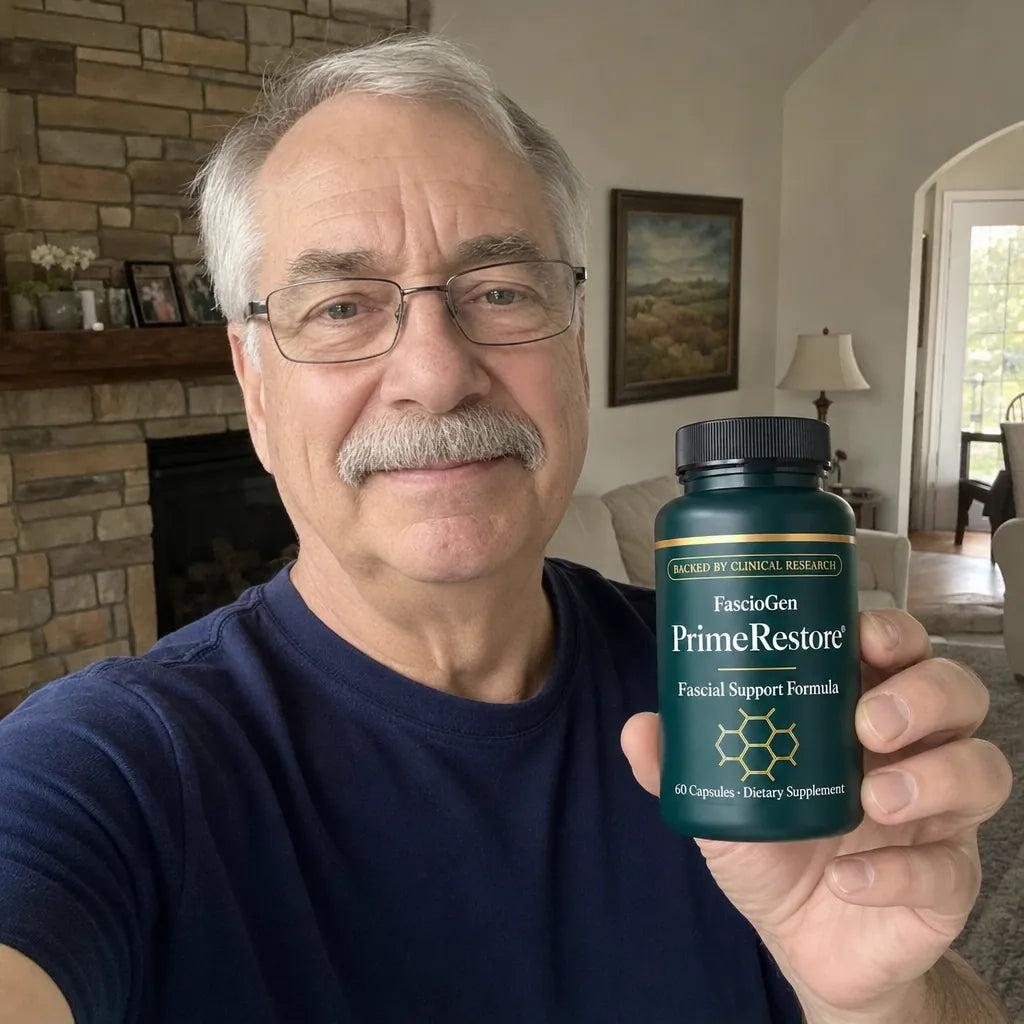
My wife said try it, what's the worst that could happen. I'm back in the bed. The morning cement is mostly gone and I've got my afternoons again. That was the thing ruining my life. Still on the pred, same as before.

Practitioners Get First Allocation
The last thing worth knowing is that FascioGen isn't always in stock.
It is made in small clinical batches in an FDA-registered, GMP-certified facility in the US. Part of every batch is set aside for the 500+ physicians and clinicians giving it out in their practices. Whatever is left goes to the public, first come, first served.
When a batch sells out, the next one takes six to eight weeks to make, and customers already on the protocol get restocks before new customers.
But if FascioGen is in stock, this is your invitation to join the thousands of people with PMR already taking it — and already waking up with less stiffness and less pain, arms that go up, less heaviness, and more energy and less fog in the afternoon.